
The Joint CSIR-UGC NET exam pattern is essential for deciding how many questions to attempt, where to invest preparation time, and how to avoid unnecessary negative marks. The examination is not identical across the five science subjects: each has its own question counts, marks per answer, and maximum attempt limits.
This guide uses the official December 2026 information bulletin. The most useful tables appear first, followed by explanations of Parts A, B and C, scoring examples, preparation strategy, and frequently asked questions.
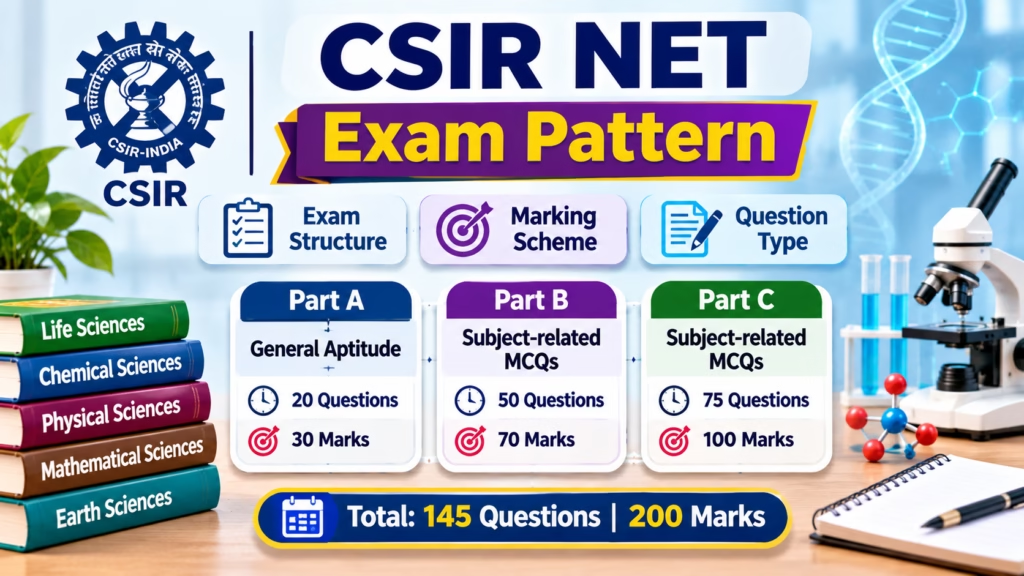
CSIR NET Exam Pattern 2026: Quick Facts
| Feature | Official scheme |
|---|---|
| Conducting agency | National Testing Agency (NTA) |
| Exam mode | Computer-Based Test (CBT) |
| Duration | 180 minutes (3 hours) |
| Maximum marks | 200 |
| Paper structure | One paper divided into Part A, Part B and Part C |
| Subjects | Chemical, Earth, Life Sciences and Biotechnology, Mathematical, Physical Sciences |
| Question type | Objective multiple-choice; subject-specific response rules apply |
| Negative marking | Varies by subject and part |
| Latest bulletin used | Joint CSIR-UGC NET December 2026 |
Subject-Wise CSIR NET Question Pattern and Marking Scheme
Chemical Sciences
| Part | Questions offered | Maximum to attempt | Marks per correct answer | Marks deducted per wrong answer |
|---|---|---|---|---|
| Part A | 20 | 15 | 2 | 0.5 |
| Part B | 40 | 35 | 2 | 0.5 |
| Part C | 60 | 25 | 4 | 1 |
| Total | 120 | 75 | Maximum 200 | — |
Earth, Atmospheric, Ocean and Planetary Sciences
| Part | Questions offered | Maximum to attempt | Marks per correct answer | Marks deducted per wrong answer |
|---|---|---|---|---|
| Part A | 20 | 15 | 2 | 0.5 |
| Part B | 50 | 35 | 2 | 0.5 |
| Part C | 80 | 25 | 4 | 1.32 |
| Total | 150 | 75 | Maximum 200 | — |
Life Sciences and Biotechnology
| Part | Questions offered | Maximum to attempt | Marks per correct answer | Marks deducted per wrong answer |
|---|---|---|---|---|
| Part A | 20 | 15 | 2 | 0.5 |
| Part B | 50 | 35 | 2 | 0.5 |
| Part C | 75 | 25 | 4 | 1 |
| Total | 145 | 75 | Maximum 200 | — |
Mathematical Sciences
| Part | Questions offered | Maximum to attempt | Marks per correct answer | Marks deducted per wrong answer |
|---|---|---|---|---|
| Part A | 20 | 15 | 2 | 0.5 |
| Part B | 40 | 25 | 3 | 0.75 |
| Part C | 60 | 20 | 4.75 | 0 |
| Total | 120 | 60 | Maximum 200 | — |
Physical Sciences
| Part | Questions offered | Maximum to attempt | Marks per correct answer | Marks deducted per wrong answer |
|---|---|---|---|---|
| Part A | 20 | 15 | 2 | 0.5 |
| Part B | 25 | 20 | 3.5 | 0.875 |
| Part C | 30 | 20 | 5 | 1.25 |
| Total | 75 | 55 | Maximum 200 | — |
The figures above are taken from the official December 2026 NTA information bulletin. For Earth Sciences Part C, the stated deduction is 1.32 marks (33% of four marks). Mathematical Sciences Part C has no negative marking, but its response format can involve multiple correct options; candidates must follow the specific instructions.
What is Part A in CSIR NET?
Part A is the common general aptitude section across the five CSIR NET subjects. It assesses reasoning, numerical ability, analytical thinking, general science, and related aptitude skills. The official pattern offers 20 questions, from which candidates should attempt a maximum of 15, each worth two marks.
Because Part A contributes up to 30 marks, ignoring it completely can make it harder to reach a competitive total. Practice quantitative reasoning and interpretation regularly, but avoid spending disproportionate time on an unusually difficult aptitude question when you have stronger subject questions available.
What is Part B in CSIR NET?
Part B focuses on subject-related knowledge and conventional conceptual questions. The number of questions and the maximum allowed attempts vary across Chemical, Earth, Life, Mathematical, and Physical Sciences. This section rewards accurate recall, clear understanding of fundamentals, and the ability to apply familiar principles.
Build Part B preparation around the official syllabus. Make short notes for definitions, laws, processes, and common problem types, and revisit errors from previous-year papers. Understanding why the wrong options are incorrect is often more valuable than memorizing the correct option alone.
What is Part C in CSIR NET?
Part C is designed to assess deeper scientific reasoning and application. Questions may require interpreting experiments, combining ideas from multiple topics, analyzing data, or solving less familiar problems. In Mathematical Sciences, Part C has its own multiple-correct response rules and no negative marking under the published scheme.
Part C preparation should emphasize working through the reasoning behind solutions. When practicing, write down assumptions, units, equations, and logical steps. Review whether mistakes came from missing concepts, misreading a condition, or making an avoidable calculation error.
How the 200 marks are distributed
The common broad allocation is 30 marks for Part A, 70 marks for Part B, and 100 marks for Part C. The distribution means the analytical section carries half of the total available marks, although the individual question values and attempt counts differ by subject.
For example, a Life Sciences candidate can earn up to 30 marks in Part A by answering 15 questions correctly, 70 marks in Part B by answering 35 correctly, and 100 marks in Part C by answering 25 correctly. The same total maximum applies to Mathematical Sciences, but the number and value of attempted questions are different.
Negative marking explained with examples
For Chemical Sciences, a wrong answer in Part A or Part B costs 0.5 marks, while a wrong Part C answer costs one mark. For Physical Sciences, the corresponding deductions are 0.5, 0.875, and 1.25 marks. Students should calculate practice scores using the correct subject-specific values rather than applying one penalty to the entire paper.
Suppose a Life Sciences student answers 20 Part C questions correctly and five incorrectly. The Part C score would be 20 × 4 minus 5 × 1, giving 75 marks, assuming all 25 attempts are within the permitted limit. This example illustrates why accuracy matters in the analytical section.
How many questions should you attempt?
The official maximum is not a target that must be reached at any cost. You should answer the permitted number only when you can make reasonable choices based on knowledge or a deliberate strategy. Candidates with strong accuracy may benefit more from selecting the best questions than from rushing through every possible attempt.
If you answer beyond the permitted number, the bulletin specifies that only the first prescribed number of responses in each part will be evaluated. This makes question order and selection important. Learn the exact interface behavior and evaluation instructions before your test date.
Time management for a three-hour CBT
A three-hour test rewards both scientific knowledge and disciplined question selection. Start by identifying relatively straightforward questions and avoid getting stuck on a lengthy calculation. Use a consistent method for flagging uncertain questions and return to them only after covering stronger opportunities.
A mock-test log can show whether you spend too long on Part A, leave easy Part B questions unanswered, or rush Part C. Adjust your strategy based on these patterns. Because subjects differ in question count and complexity, no single time split works equally well for everyone.
Subject-specific preparation: Chemical Sciences
Chemical Sciences candidates should combine physical, organic, inorganic, and interdisciplinary concepts according to the current syllabus. Practice reaction mechanisms, spectroscopy, structure and bonding, thermodynamics, kinetics, and numerical problems where relevant to the published units.
Part C often requires connecting several ideas, so focus on explanation and application rather than isolated fact lists. After each timed test, classify errors by topic and by the type of reasoning required. This helps identify whether a weakness is conceptual, mathematical, or procedural.
Subject-specific preparation: Earth Sciences
Earth Sciences covers a wide range of physical and environmental systems. Organize preparation around the official syllabus and use diagrams, processes, maps, and data interpretation to connect topics. Part C carries a 33% deduction for incorrect answers in the published 2026 scheme.
This relatively higher Part C penalty makes careful selection particularly valuable. Practice recognizing when the available information is sufficient for a reliable answer, and avoid treating uncertain questions as opportunities for unrestricted guessing.
Subject-specific preparation: Life Sciences and Biotechnology
Life Sciences and Biotechnology preparation benefits from integrating molecular biology, genetics, cell biology, biochemistry, physiology, ecology, evolution, and experimental methods according to the applicable syllabus. Questions may test both factual understanding and interpretation of research-style scenarios.
Practice diagrams, experimental controls, graph interpretation, and quantitative reasoning. Keep an error notebook for techniques and pathways that are frequently confused. Use the latest CSIR HRDG syllabus because subject naming and syllabus documents can change between cycles.
Subject-specific preparation: Mathematical Sciences
Mathematical Sciences has a distinctive marking scheme: Part B correct answers are worth three marks, Part C correct answers are worth 4.75 marks, and Part C has no negative marking. The maximum evaluated attempts are 15 in Part A, 25 in Part B, and 20 in Part C.
Work carefully with proofs, definitions, and problem-solving techniques. The absence of a Part C penalty does not remove the need to understand its multiple-correct response instructions. Practice with official model questions so you know how a response is considered correct.
Subject-specific preparation: Physical Sciences
Physical Sciences offers fewer total questions than several other CSIR NET subjects, but individual subject questions can carry relatively high marks. Part C correct answers are worth five marks and wrong answers cost 1.25 marks.
Build fluency in core principles, mathematical methods, and multi-step numerical solutions. Practice checking units, limiting cases, and assumptions. In timed tests, a structured approach to calculations can reduce errors and make difficult questions easier to evaluate quickly.
Previous-year papers, mocks, and revision
Previous-year papers reveal how theoretical ideas are converted into examination questions. Use them to assess difficulty and timing, but do not assume a repeated question will appear. Solve a full paper under realistic conditions before reviewing worked explanations.
After every mock, record three things: topics you did not know, questions you knew but answered incorrectly, and questions you skipped because of time. The first category needs study, the second needs accuracy practice, and the third needs a better selection strategy.
Exam-day and CBT instructions
The computer-based test is conducted according to the date, shift, and examination center shown on the admit card. Read the official instructions about reporting time, identification, permitted items, and the test interface. Arriving with the correct documents is as important as being prepared academically.
Do not assume that a calculator, notes, electronic device, or personal stationery is permitted. The bulletin lists barred items and allowed materials. Review it shortly before the exam because administrative instructions may be revised through official notices.
Understanding results and qualifying categories
CSIR NET results can qualify candidates for JRF and Assistant Professor eligibility, Assistant Professor and PhD admission eligibility, or PhD admission only. The category obtained depends on the applicable rules and result, not merely on attempting a particular number of questions.
The official bulletin also states that there is no separate cutoff for Parts A, B, and C; cumulative marks are considered. Minimum benchmark percentages are not the same as the final competitive cutoff, which may depend on the result category, subject, and other factors.
How to use this guide effectively
Start by identifying the exact decision you need to make about CSIR NET examination scoring and attempts. A candidate checking basic eligibility should not have to read a long preparation strategy first, while a student comparing question distributions should be able to reach the relevant table immediately. This guide therefore places the practical facts above the supporting explanations.
Read the official bulletin for your particular examination cycle before submitting an application. Exam bodies can revise schedules, definitions, accepted documents, or administrative procedures. An educational website can explain the rules, but it cannot replace the binding instructions issued by the examination authority.
Common mistakes students should avoid
One common mistake is to rely on a screenshot or social-media post without checking its date. Another is to assume that all NET examinations use the same rules because their names are similar. Always identify the examination, session, subject, and applicable official notice before making a decision about CSIR NET examination scoring and attempts.
Students also lose time when they collect many resources without a clear plan. Keep a short checklist, compare your own circumstances against the current requirements, and write down questions that remain unresolved. Where a rule depends on your degree, category, or institution, seek confirmation from the responsible authority rather than relying on an unsupported assumption.
Practical checklist before you proceed
Confirm the examination name and the relevant session. Download the official information bulletin and save a copy for reference. Locate the section addressing CSIR NET examination scoring and attempts, read the definitions and exceptions, and note any documents or deadlines that apply to you.
After checking the requirements, create a simple study or application calendar. Allow time for collecting certificates, verifying personal details, reviewing the syllabus, and practicing under realistic conditions. Keep a copy of official notices, application confirmations, and correspondence so that important information is easy to retrieve later.
Official reference and update note
This guide uses Chapter 3 of the Joint CSIR-UGC NET December 2026 information bulletin and the CSIR HRDG examination scheme. Confirm any later corrigendum or updated subject scheme before your examination. The document was checked in November 2026.
Frequently Asked Questions (FAQs)
How many marks is CSIR NET 2026?
The maximum is 200 marks for each of the five notified subjects.
Is CSIR NET a two-paper examination?
No. It is one paper divided into Parts A, B and C.
How many questions can Life Sciences candidates attempt?
The maximum is 15 in Part A, 35 in Part B, and 25 in Part C: 75 in total.
Is there negative marking in Mathematical Sciences Part C?
No. The December 2026 scheme states that Part C has no negative marking.
What is the duration of CSIR NET?
The duration is 180 minutes, or three hours.
Does every subject have the same question count?
No. The questions offered and maximum evaluated attempts differ across subjects.
Is there a separate passing mark for each part?
The official bulletin states that there is no separate cutoff for Parts A, B and C; cumulative marks are considered.
What happens if I attempt too many questions?
The official bulletin specifies that only the first permitted number of responses in each part are evaluated.
Which section is analytical?
Part C primarily tests application and scientific reasoning.
Where can I find the latest official scheme?
Use the NTA CSIR NET information bulletin and the CSIR HRDG exam scheme.