
Preparing for CSIR NET Physical Sciences and wondering which reference books to choose? Physics preparation requires both a strong understanding of concepts and regular practice with mathematical problems. A few well-chosen textbooks can help you study more effectively than a large collection of books you never finish.
Below you will find recommended physics books, our original downloadable book-list PDF, free and authorized learning resources, and a detailed subject-wise study guide. Use these alongside the CSIR NET Physical Sciences syllabus and previous-year question papers.
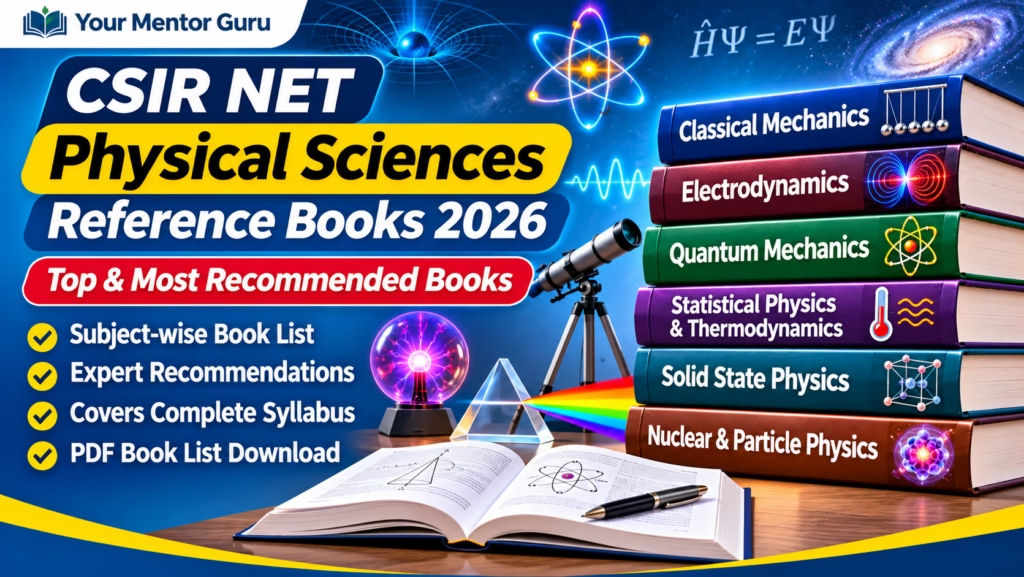
Recommended CSIR NET Physical Sciences reference books by subject:
| Subject | Recommended book | Author(s) |
|---|---|---|
| Mathematical Methods | Mathematical Methods for Physicists | George B. Arfken, Hans J. Weber and Frank E. Harris |
| Classical Mechanics | Classical Mechanics | Herbert Goldstein, Charles P. Poole and John L. Safko |
| Electromagnetic Theory | Introduction to Electrodynamics | David J. Griffiths |
| Quantum Mechanics | Quantum Mechanics: Concepts and Applications | Nouredine Zettili |
| Quantum Mechanics | Introduction to Quantum Mechanics | David J. Griffiths and Darrell F. Schroeter |
| Thermodynamics and Statistical Physics | Fundamentals of Statistical and Thermal Physics | Frederick Reif |
| Electronics | Electronic Devices and Circuit Theory | Robert L. Boylestad and Louis Nashelsky |
| Condensed Matter Physics | Introduction to Solid State Physics | Charles Kittel |
| Nuclear and Particle Physics | Introductory Nuclear Physics | Kenneth S. Krane |
CSIR NET Physical Sciences Book List PDF
Download our original PDF containing a short list of recommended physics reference books. This is a book-list PDF, not a collection of full commercial textbooks.
View / Download Physics Book List PDFFree Physics Textbooks and Study Resources
The standard books in the table are mostly commercially published. The following resources offer legitimate free online reading and, where the provider supports it, downloadable textbooks or course materials. They are supplementary resources, not substitutes for checking the current exam syllabus.
OpenStax University Physics — Volumes 1, 2 and 3
Free university-level physics textbooks covering mechanics, waves, thermodynamics, electricity, magnetism, optics and modern physics. Select a volume and use the publisher’s PDF download option.
Browse free textbooks and PDF optionsMIT OpenCourseWare — Physics
Free lecture notes, assignments and selected course materials for undergraduate and advanced physics topics. Availability of downloadable PDFs depends on the course.
Explore free physics coursesPhysics LibreTexts
Open-access physics books and learning modules covering classical, electromagnetic, quantum and thermal physics. Individual books may provide PDF or print options.
Read free physics textbooksFeynman Lectures on Physics
Official free-to-read online edition of the classic physics lectures, useful for developing conceptual understanding. Online reading is provided; a general free PDF download is not promised.
Read the official online lecturesNPTEL Physics Courses
Free university-level video lectures and course materials from Indian institutions. Some courses include downloadable notes or assignments.
Browse NPTEL coursesBest CSIR NET Physical Sciences Reference Books — Detailed Subject-wise Guide
The subject areas below reflect the main physics disciplines commonly tested. Always match the chapters in your chosen edition with the official syllabus, as textbook contents and exam coverage are not identical.
Mathematical Methods of Physics
Recommended books: Mathematical Methods for Physicists — Arfken, Weber and Harris
Begin with vector calculus, linear algebra, differential equations, complex analysis, Fourier methods and special functions. Mathematical methods appear throughout physics, so work through derivations and practise choosing the correct technique for a problem.
Classical Mechanics
Recommended books: Classical Mechanics — Goldstein, Poole and Safko
Use Goldstein for Lagrangian and Hamiltonian formulations, central-force motion, oscillations and rigid-body dynamics. If you find the treatment too advanced, revise Newtonian mechanics from an introductory textbook first. Focus on setting up equations of motion and solving unfamiliar configurations.
Electromagnetic Theory
Recommended books: Introduction to Electrodynamics — David J. Griffiths
Griffiths offers a structured approach to electrostatics, magnetostatics, boundary-value problems, electromagnetic induction and Maxwell’s equations. Practise calculating fields using symmetry and understanding the physical meaning of boundary conditions.
Quantum Mechanics
Recommended books: Quantum Mechanics: Concepts and Applications — Nouredine Zettili; Introduction to Quantum Mechanics — Griffiths and Schroeter
Zettili is particularly useful for worked problems, while Griffiths and Schroeter provide accessible conceptual explanations. Focus on operators, eigenvalues, angular momentum, approximation methods, perturbation theory and standard model systems.
Thermodynamics and Statistical Physics
Recommended books: Fundamentals of Statistical and Thermal Physics — Frederick Reif
Study thermodynamic laws, potentials, Maxwell relations, ensembles, partition functions and quantum statistics. Pay attention to how microscopic assumptions produce macroscopic results, and practise numerical and derivation-based questions.
Electronics and Experimental Methods
Recommended books: Electronic Devices and Circuit Theory — Boylestad and Nashelsky
Review semiconductor devices, transistors, operational amplifiers, digital logic and circuit analysis. Complement textbook reading with practice in measurements, error analysis, graphs and experimental interpretation, using reliable course notes where needed.
Condensed Matter Physics
Recommended books: Introduction to Solid State Physics — Charles Kittel
Kittel is a major reference for crystal structures, reciprocal lattices, diffraction, phonons, free-electron models, band theory and magnetism. Make diagrams of lattices and band structures and practise problems involving reciprocal space.
Nuclear and Particle Physics
Recommended books: Introductory Nuclear Physics — Kenneth S. Krane
Use Krane to review nuclear properties, decay, reactions, nuclear models and radiation interactions. Supplement particle-physics topics from current university notes where the book is less comprehensive. Check the exact author and edition of any other nuclear-physics text before relying on a citation.
Atomic and Molecular Physics
Recommended books: Introduction to Quantum Mechanics — Griffiths and Schroeter; relevant university lecture notes
Connect quantum principles to atomic spectra, angular momentum coupling, selection rules, molecular rotations and vibrations. Work through spectra and energy-level diagrams rather than memorizing isolated formulas.
CSIR NET General Aptitude Books
Part A tests general aptitude rather than subject-specific physics. Practise numerical reasoning, logical reasoning, data interpretation and quantitative comparisons using CSIR NET-style questions. A general aptitude practice book can help, but timed practice and error review are essential.
Do You Need Every Physics Reference Book?
No. Start with one dependable reference for each major area you are studying. Use a second book when you need more worked examples or a clearer explanation. Advanced books such as Goldstein and Kittel are valuable, but reading them cover to cover is rarely the most efficient preparation strategy.
How to Use These Books During CSIR NET Preparation
- Check the topic against the current official syllabus.
- Study the core theory and derive the important equations.
- Work through solved examples without skipping mathematical steps.
- Attempt previous-year and topic-wise questions under time limits.
- Record mistakes, revise weak concepts and repeat difficult problems.
Can You Download CSIR NET Physical Sciences Books as PDFs?
Some textbooks and course notes are legally available at no cost through OpenStax, LibreTexts and educational institutions. Standard commercial titles such as Goldstein, Griffiths and Kittel are not automatically free to redistribute. Use a publisher, authorized library or legally licensed edition to access them. Our PDF above is a list of book recommendations, not full textbook copies.
How to Choose the Right Reference Books for Physical Sciences
- Start from the syllabus: Match the book chapters with the topics you actually need.
- Choose your level: Begin with a more accessible text if an advanced reference is difficult to follow.
- Prioritize problem solving: Look for clear worked examples, especially in mathematical methods, quantum mechanics and electromagnetism.
- Avoid unnecessary duplication: One main book per area is usually enough to start.
- Combine reading and testing: Use previous-year questions to identify which topics need deeper study.
Frequently Asked Questions
Which books are best for CSIR NET Physical Sciences?
Commonly used references include Goldstein for classical mechanics, Griffiths for electromagnetism, Zettili for quantum mechanics, Reif for statistical physics and Kittel for condensed matter physics. Choose according to your preparation level.
Is one book enough for the entire Physical Sciences syllabus?
No single textbook covers all major subjects in the depth needed. A small selection of complementary references is usually more useful.
Where can I download the Physical Sciences book-list PDF?
Use the book-list PDF button above. It contains recommended titles and is not a bundle of commercial textbooks.
Are free physics textbooks available as PDFs?
Yes. OpenStax offers free physics textbooks with PDF options, and some educational platforms provide downloadable course notes. Download availability varies by resource.
Which book is best for quantum mechanics numerical problems?
Zettili is well known for its worked examples and practice problems. Griffiths and Schroeter is also useful for understanding the underlying concepts.
How should I prepare for Part A?
Practise quantitative aptitude, reasoning and data interpretation regularly, and review errors from timed practice sets.
Should I finish every textbook before attempting previous-year papers?
No. Solve previous-year questions throughout your preparation to identify gaps and strengthen problem-solving skills.
Also Check Out
Have a question about choosing physical reference books? Share the topic you are preparing for in the comments and we will try to help.